Showing posts with label Pink Triangle. Show all posts

January 27, 2008

HOLOCAUST HONOUR


"Work makes you Free"

The motto on the gates of Sachsenhausen Concentration Camp at Orienburg, near Berlin.
Sachsenhausen was a Work Camp for Political prisoners, and many of the deaths here were due to the harsh working conditions, brutality and starvation. Work set nobody free here.


HOLOCAUST MEMORIAL DAY (HMD)
The Nazi concentration camp Auschwitz-Birkenau was liberated on January 27th and this date has bneen chosen as Holocaust Memorial Day.

The idea of HMD is to commemorate and to educate people about the Nazi Holocaust, but this commemoration is inclusive of all the victims, not just the Jews. People of religions other than Israelites were persecuted by the Nazis, and also people seen as 'political' or anti social or just selected for punishment. Gypsies, Criminals, Priests, Homosexuals, Disabled, Prisoners of War were all victims of the Nazi Holocaust and HMD seeks to commemorate those lives as well.

Whilst the events of World War Two may be considered as 'The Holocaust', sadly it is now recognised that there have been many more holocausts since 1945 and even today people are being persecuted and 'ethnically cleansed' in a manner all too similar to the Nazi ways.

Recent holocausts include Cambodia, Bosnia, Rwanda and Darfur, and HMD seeks to ensure that such genocides are not forgotten and are not repeated. For Jewish victims of The Holocaust there is a rememberance day in April each year.


Almost everybody knows of the yellow star of David worn by Jewish prisoners, but in fact this was two yellow triangles put together. There were many other triangles, such as red for political prisoners (an apex up red triangle was used for Prisoner of War such as captured airman, seaman or soldiers). Pink Triangles for male homosexuals, green for criminals, brown or black for Gypsies, and lots of combinations.


A memorial to male homosexuals. Some 50,000 men died in camps having worn the pink triangle to indicate their sexual orientation.


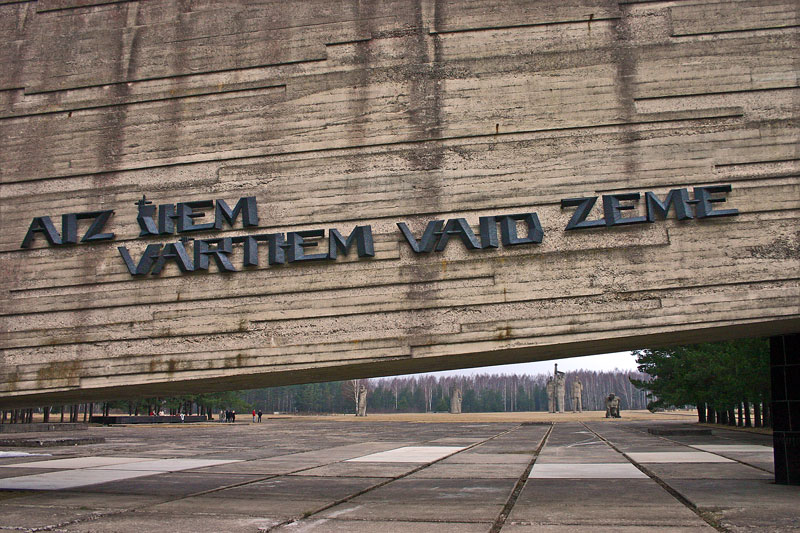
"Behind this Gate the earth moans"
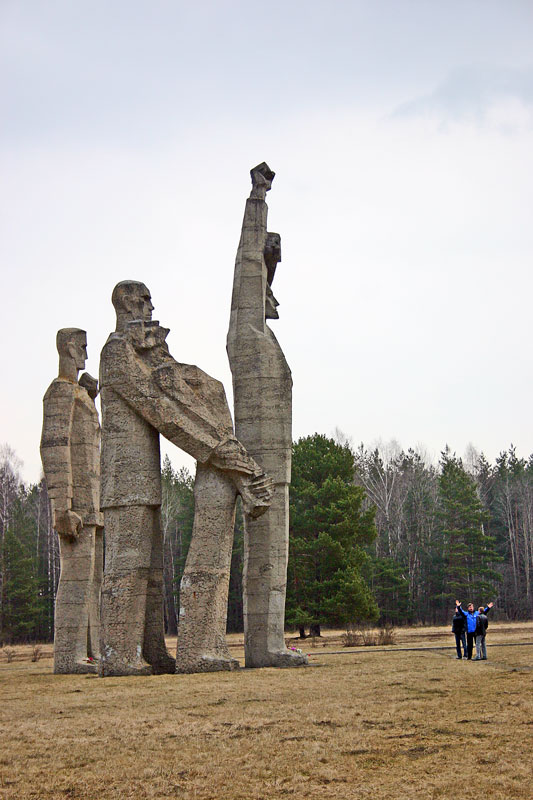
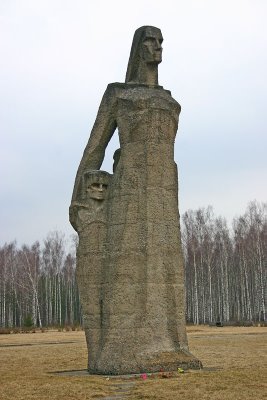
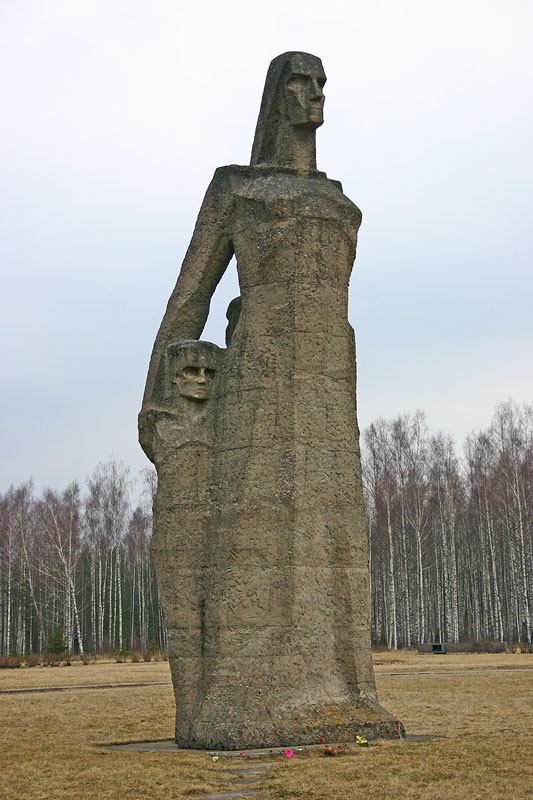
Another country, another camp. Latvia was occupied by the Nazis on their way to the Russian front, and very quickly the concentration camp ethic was installed. Salaspils near Riga had a Transit Camp/Work Camp whose brutal regime caused the death of about 50,000 people from the Baltic States and from eastern europe, mostly gentiles.

For more information on Latvian camps, click on Salaspils


Polish writer, victim of the Warsaw Ghetto, contributor to the Warsaw Uprising, and one time inmate of Sachsenhausen concentration camp, pens an epitaph to the Holocaust. Oh, if only things were that simple. Human differences will cause more holocausts as one group try for supremacy or eradication of a pereceived different group.
In Kenya on this very day The Holocaust will seem like a million miles away, but will seem very, very close to those who are being burned in their churches or hacked to death on the streets.

STOP IT.


Sachsenhausen, BerlinSalaspils, Latvia

December 16, 2007

BERLIN: THE MAN, THE WALL, THE GATE, THE STAG, AND THE CAMP

Before reunification, Germany was divided into West Germany and East Germany, the joins coming together in Berlin where the city was partly in the West and partly in the East. There were many differences, such as the Tram system being mainly in the East. Traffic was also different, East Berlin designed a 'friendly' little signal to protect its pedestrians from Ladas, Moskvitch, Skodas, Trabants, and Wartburgs, and these have been retained in parts of Berlin today, due to popular demand. West Germany had a generic Green Man to guide people across in front of its BMW, DKW, Fords, Glas, Merecedes-Benz, NSU, Opels, and VWs. The picture below shows East and West versions.

Ampelmännchen (on the left) was created in 1961 by an East German Traffic psychologist hopeful of getting obedience by appealing with a friendly little hatted mascot. On Re-unification Germany tried to impose its generic Green Man (right) on its eastern roads, but the citizens would not let go of their Ampelmännchen.

In 1961 Berliner Mauer went up to prevent the leakage of people from the Communist East to the Capitalist West. The picture shows a small section left standing after The Wall was broken down in 1989. Don't be deceived by this neat, smooth faced wall with its softly rounded top. This was only the wall that faced the West, on the inside there were lines of barbed wire, moats, ditches, mines, automatic guns, lights, sensors. And if you got through all that, the Stasi took vengeance on those you left behind. In other parts of Berlin, the route of the Berlin Wall is traced on the ground with lines of cobbles.

The Berlin Wall was erected in 1961 and pulled down in 1989 and formed the the most notorious part of the 'Iron Curtain'. Some 128 people are recorded as dying trying to escape from East to West Berlin. Apparently 5000 people escaped from East Germany to West Germany, some 2000 of those being Border Guards. (The wire netting is a modern attempt to stop the wall being chopped up for souvenirs or being plastered with graffiti - some hope!)


Here is the Brandenburger Tor, a triumphal gate erected by Freidrich as an entrance to Berlin on the road from Brandenburg. It has always been symbolic for Berliners, and therefore for others who seek to make a big entrance to Berlin. When the Berlin Wall went up, the Brandenburg Gate became a rallying point for opposition to Soviet Rule and for Peace events. Since 1990 it has become a rather tame tourist attraction and now has ghastly modern architecture Embassies, businesses and posh hotels alongside it.


Brandenburg Gate was commissioned by Friedrich Wilhelm II in 1788 to a classical design based on the gateway to the Acropolis in Athens. Topped by a fraulein (Viktoria) in a Quadriga (Chariot) because Mercedes-Benz were not yet made. She represents Victory, but has indeed been a victim of defeat, being stolen in 1806 by Napoleon when he defeated the Prussians, and then hauled back to Berlin in 1814 when the nasty little Corsican upstart got his come uppance. Viktoria got a bit bent and her chariot's wheels went flat during the struggles in 1945, but eventually she got dusted off and renovated to symbolise victory over communism when The Wall came down in 1989.


Modern Architecture knows no bounds, witness to this is the collision between a glass pudding bowl and the German Parliament building; the Reichstag. Opened in 1894, "Reichstag" was the parliament of Germany until 1933 and this was the Reichstag building. After the little Austrian Dictator came to power, the Reichstag building burned down amidst rumours of Communist plots but also of Brown Shirts vandalism; who knows. The result was that the building became a ruin and stood as a metaphor for the ruins of the German government. When democracy returned after WWII it returned to Bonn and the parliament then was called "Bundestag". The fall of the Berlin Wall determined the Bundestag to return to the Reichstag building and to get Sir Norman Foster to destroy it or renovate it. You decide.

Berlin's Reichstag houses the German Parliament ('Bundestag'). It was re-opened in 1999 having been almost derelict since the fire of 1933, although some bad reconstruction was made in the 1960s. Sir Norman Foster won the 1990s competition and added the immense glass Cupola onto a building he gutted to a bare shell. I am not a fan of modern architecture, and wonder about the purpose of this glass pudding bowl; it looks like a superfluous gesture of attention-seeking rather than anything with any true function


Sachsenhausen was opened on the outskirts of Berlin in 1936 for mainly political prisoners. It housed approximately 200,000 prisoners who were sent there principally for 'crimes' such as political, or anti-social. This prison housed Gypsies, Criminals, people with disabilities, foreign prisoners of war, Jehovahs Witnesses and other religious groups, including 2 entire huts of Priests. It was for men only, although there were also some youths who were used for medical experimentation. The picture shows a memorial to Homosexuals who were sent here and identified by Pink Triangles, I use the word 'Camp' in my title to give extra emphasis to the forgotten thousands who died in these camps. See Salaspils Seen for my Blog about a Latvian Nazi Work Camp. The history of the Holocaust is often very partial.
Memorial to Homosexual men who were victims of the Sachsenhausen Concentration Camp. Homosexual men were regarded as criminals or ant-socials by the Nazi regime, and this was enough to get them sent to Work Camps such as Sachsenhausen. Forced to wear Pink Triangles on their striped uniforms, at least 50,000 Pink Triangles died of the harsh work.


(see Wikipedia for notes on the badges worn in these camps).

April 15, 2006

SALASPILS SEEN

Today Juris and I visited Salaspils near to Riga in Latvia. In World War 2 this was a Concentration Camp to collect together workers for the Third Reich.

The photos show the long long concrete entrance '"gate" the inscription reads:

'Behind this gate the ground contains GROANS'


Concentration Camps were used by the Nazis during WW2 to exterminate 6,000,000 Jews. This is the view which is predominated and which ignores all the other people who died and ignores all their stories too.

Non Jewish people also died in WW2, and here at Salaspils is proof; a Concentration Camp for workers made up of Latvian political prisoners, as well as people from Hungary, Poland and Romania.


Jews from the Riga ghetto were employed to construct this camp during the winter of 1941, but within a year its 2000 inhabitants were non-Jewish and made up of people from Baltic states and from other neighbours.

KZ-Salaspils became a work and transit camp for prisoners from Belorussia in 1943 as they were transferred to work in Germany. 1944 its occupants were Latvian freedom fighters.

Between 53,000 and 100,000 prisoners died here, killed by cold, hunger, brutality, and by executions for disobedience. The exact number is uncertain because different counting methods are used.


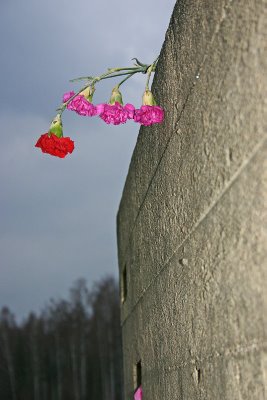
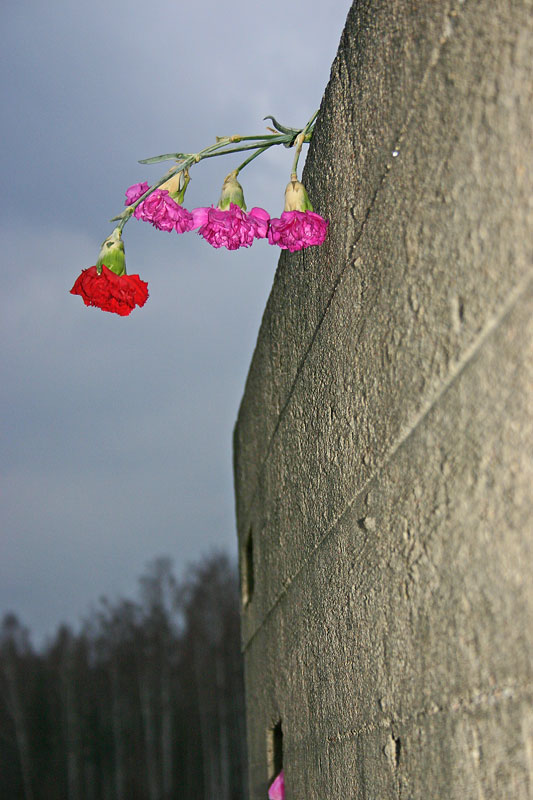
The flowers hang over the edge of a monumental stone which stands to mark the spot where thousands of inmates were hung for misdeeds.


Sachsenhausen, BerlinSalaspils, Latvia