Showing posts with label latvia. Show all posts

September 15, 2009

RIGA BEFORE RUSSIA

On the day before we left Riga for Russia we explored some other aspects to Riga.

Sunday started damp; it had rained a little during the night and the grey clouds told of a gloomy day ahead with the possibility of precipitation.

Although late to bed because of the Fireworks, an early start was necessary because Juris had a lecture to attend. We walked to the end of our lane and took one of the Minibus coaches into Riga. These are privately run as an addition to the efficient council run bus services. Using Shagged out Charabancs probably imported from Germany or another neighbour ours was a 15-seater Renault but with no actual limitation to 15 passengers. It works and returned us to Riga centre in 25 minutes for just 0.45Lats (about 60pence).

We walked down slightly tired streets past jaded buildings that clearly had seen a much more prosperous time about 100years ago, and then many new economic dawns that had turned out to be very short grey days instead. 

So some of the buildings are original and have a patina, whilst others have been yuppified or more recently become abandoned future projects.  Latvia has been well and truly credit-crunched and is at least financially bankrupt.

We gained entry into an original building and took our places within a modest apartment converted to a Buddhist Mission.  There a guest speaker from Germany gave a long exploration of the concept of "Voidness" and I won't attempt to explain it as I am sure Google will do a better job. He spoke in perfect English and every paragraph or so was then translated by another man into Latvian. For more than 2hours we explored Mantra, Tantra and the Heart Sutra and then we walked back into the real world.

Well not quite. The gloomy afternoon suggested an indoor pursuit so we headed to the central Multiplex and viewed Tarantino's latest film "Bedigi slavenie mergli".

Tarantino's oeuvre really isn't my cup of tea, and "Inglorious Basterds" (in English) is a fanciful and fictitious festival of gore really NOT to my taste at all.  It was an interesting experience, however, because the film was screened in "English" with both Latvian and Russian subtitles.  However, much of the dialogue is actually spoken in French or German and would have had English subtitles to interpret.  Lacking these English clues I was failed by my French and absence of German. The violence translated.

This film is supposed to be on a theme of revenge, well in my opinion it is merely a self-indulgent revenge by Tarantino on the public for not liking his last two movies.

And so Riga centre where we opted to take a boat trip on the Daugava River.  On a grey evening the boat cruised slowly up the river towards Lithuania until it reached the new Red Bridge before turning and heading back towards the Baltic Sea end of Riga. There were only about 6 passengers and no commentary, so it was quite a solemn little passage.  As we were turned to regain our dock, the sun broke through the evening clouds and some photos were possible.  People who boarded this cruiser after us enjoyed a much sunnier cruise.

We turned for our lodge at Jaunmarupe, managing to miss a couple of buses on the way, but flagging down the 2003 Taxi Bus for the bouncy return.


From the Daugava River showing the arched roofs of the Zeppelin Market and the Soviet-built tower Stalinist Academy of Sciences building.


View from the Daugava with the spire of the Dome Cathedral (left) and St Peter’s (right)


From the Tower of St Peter's Church looking towards the Dom Cathedral and the Daugava River beyond


Riga Skarnu Street, in the Old Town showing the stepped end wall of St Johns Church


Riga Brivibas iela. 'Freedom Street', this street runs straight through the city and hardly curves at all as it becomes the A2 and takes traffic away from Riga. The Freedom Monument is also visible and behind the Russian Orthodox Nativity of Christ Cathedral.
From Latvia 2009 [a PICASA album by RedSimon]

December 20, 2006

2006: AN ELL OF A YEAR

Last Christmas I wrote of spending a lot of time with a newly found Latvian friend who then returned to study in Riga in autumn 2005. Well I didn't honestly know whether we would meet again, but 2006 has provided us with many chances to meet up. My family time has been limited during 2006 because I needed to make the best of another kind of relationship that hasn't been available to me before.

Easter, as you may already know from previous correspondence, was spent with Juris in Latvia, Lithuania, and St Petersburg.
(see http://simonsred.blogspot.com/2006_04_01_archive.html for Blog) This trip has had a major impact on me, and I really want to explore Eastern Europe more in the coming years.

St Petersburg was quite amazing, and we packed a lot of visits into our six days there. The highlights for me were not the Grand Palaces and Churches but much more down to earth things. Such architecture was mainly "non-Russian" and I am not a great fan of Baroque and prefer Neo-Classical to be ACTUAL classical such as I am familiar with in Italy.

Very impressive, nonetheless, but what was viewed was usually only about a decade old after having been restored or even rebuilt to right the ravages of Nazi occupation and post war austere Communism.

I enjoyed walking on my own into an internet Cafe where nobody spoke English and using equipment that didn't even have the same alphabet as mine, and which only had unlicensed pirated software on it. People of all nationalities were around me cruising porno and chat up sites whilst I innocently passed on the day's thoughts and pictures to family and friends back home. I say "innocently" with caution, because I actually got fined - and almost arrested - for photographing the nameplate on a Metro station; yet another highlight.

And finally SPB allowed us to celebrate the SECOND Easter of our holiday when we attended the Saturday Night service for Orthodox Easter Sunday, and joined in a midnight candlelit procession outside and around the Vladimiri church whilst traffic on a main thoroughfare was halted and thousands stood to watch.

We arrived in SPB on the night train from Riga and what a treat this was; Orient Express and all that but in a charmingly tired and rather run down version. We travelled First Class, but that didn't give us any more sleep than the second class travellers - just more privacy.

We chugged through the Baltic night at about 40mph sometimes adding - or shedding - engines and carriages and stopping for unknown reasons.
The border stop just before midnight meant we had to present our documentation to exit EU, and about half an hour later we had to get permission to enter the "USSR", but they don't call it that anymore. Russian formalities demanded four people check us out, most of them being retired Olympic female shot putters, 2 pieces of paper had to be signed, and the cabin had to be searched. Sleep was really rather pointless after that.

My view of Russia was a little shaped by the extraordinary sights I had already enjoyed in the Baltic states, so SPB had an uphill battle to compete.

Oh I didn’t see any Grand Palaces (Well actually, there was Pilsrundale near Bauska), but I did see very moving evidence of the turbulent history of these States. The open air museum at Brivdabas contained dismantled and reconstructed farmsteads from the 4 regions of Latvia that showed how human life was lived in the rural. Salaspils showed how human life was lived in the raw; man's inhumanity to fellow man.

Here a concentration camp where almost 100,000 died, but forget "Schindler's List" for Salaspils scarcely has a mention in the Jewish Holocaust record. This concentration camp killed gentiles from Riga and neighbouring states who showed opposition to the Nazi occupation; they worked themselves to death in the camp or died because they would not work.

And when the Nazis retreated from the Baltic States the advancing Russian army dealt brutally with anyone who had saved themselves from German attrition by collaborating. It seems that whichever side you were on in the Baltic States, you were bound to lose; quite a contrast to the British experience.

In Riga town there is evidence of the awful struggles that occupied this land during WW1 where Germans and Russians battled over the Daugava River, and then the Russians split into Bolsheviks and carried on pushing the Germans back. But since 1989 the Baltic countries have been pushing the Russians back; trying to reduce evidence of Russian occupation and recover evidence of their own nationality and national culture.

In Lithuania we went to our first Easter, attending the evening service at a grand 1930s Cathedral that had only been opened after years of restoration to get it back from being a Russian radio factory and warehouse and consecrate it.

In Kaunas too we saw replacement monuments to Lithuanian freedom fighters and other figures destroyed by Russian Rule.

In the Lithuanian countryside we came across the Hill of Crosses at Siauliai; a place where Lithuanians had marked their Christianity and kept alive their cultural identity for 800 years by erecting crucifixes on a little hill to create their own Calvary. We gave a lift to a hitch hiker who told how Russians had kept destroying the crosses but people simply returned and erected more; he told too how these state-sponsored vandals often died soon after their dastardly deeds.

Whilst driving towards Kaunas we entered a small country town and towering over all the wooden Baltic bungalows and the Russian-built 5storey apartment blocks was a blooming great Basilica. Church and Monastery of the Lord Revelation for St. Mary the Virgin (Dotnuvos Viešpaties apreiškimo Švè. Mergelei Marijai bažnyèios ir vienuolyno ansamblis). We found ourselves being 'collected' by an old lady washing the floor. We followed her nervously across the church yard and into a large building which turned out to be the Monastery.

A small boy was despatched and returned with a jolly rounded Priest who spoke good English and invited us to tour his humble place of worship. However, he had to attend a meeting and asked us whether we would let his father guide us, and this he did communicating to us - well to Juris at least - in Russian. We had an extraordinary tour of the church, the empty monastery and an attic room containing hundreds of church vestments which take religious dress back many centuries.

A unique experience and only made possible by my Russian-speaking companion. Oh I could go on for ever. Latvia and Lithuania changed me, and I really must return.

Here is Europe as I didn’t know it. Here is heritage and culture that we actually share - Latvian wood was used in Henry 8th's Britain - here is Christianity and common ideas that we have cast aside to embrace other cultures that are quite literally foreign to us.

Click these links below for Photo Albums:

The Baltic States
Latvia and Riga
Lithuania
Russian Cars

St Petersburg
Churches of St Petersburg
St Petersburg Palaces

Latvia, Lithuania, Lenigrad, Loves, Lives - one "L" of a year was 2006 for me. I am looking forward to "Heaven" in 2007 !!!

April 15, 2006

SALASPILS SEEN

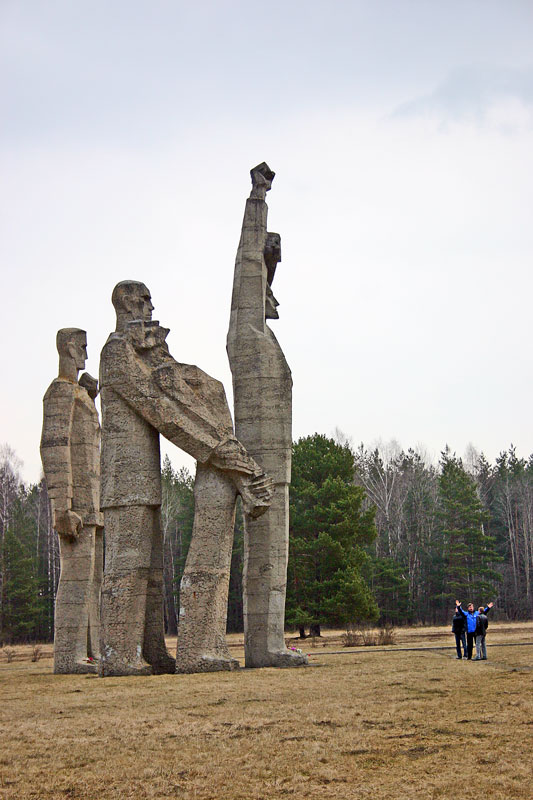
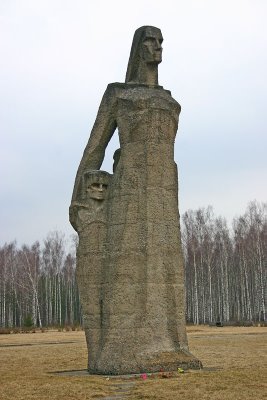
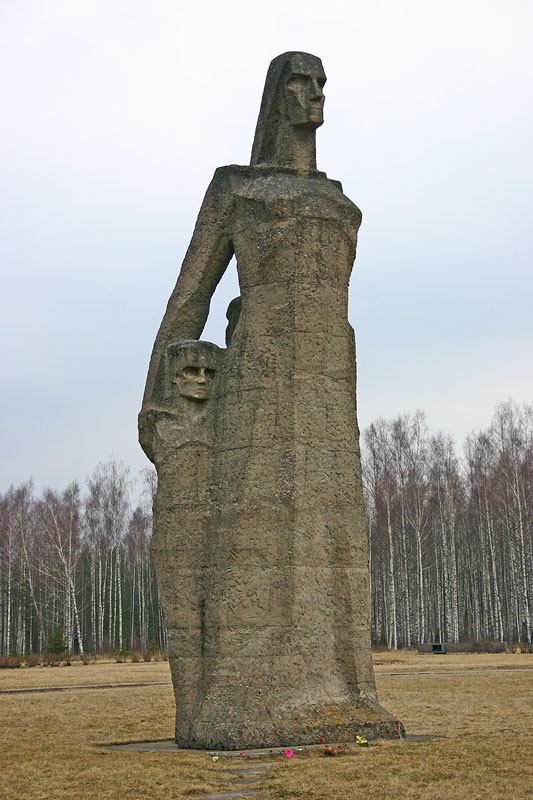
Today Juris and I visited Salaspils near to Riga in Latvia. In World War 2 this was a Concentration Camp to collect together workers for the Third Reich.

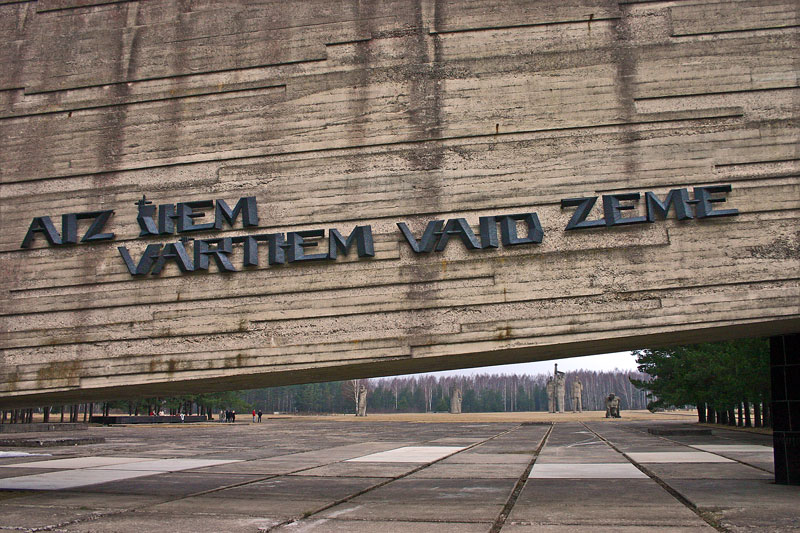
The photos show the long long concrete entrance '"gate" the inscription reads:

'Behind this gate the ground contains GROANS'


Concentration Camps were used by the Nazis during WW2 to exterminate 6,000,000 Jews. This is the view which is predominated and which ignores all the other people who died and ignores all their stories too.

Non Jewish people also died in WW2, and here at Salaspils is proof; a Concentration Camp for workers made up of Latvian political prisoners, as well as people from Hungary, Poland and Romania.


Jews from the Riga ghetto were employed to construct this camp during the winter of 1941, but within a year its 2000 inhabitants were non-Jewish and made up of people from Baltic states and from other neighbours.

KZ-Salaspils became a work and transit camp for prisoners from Belorussia in 1943 as they were transferred to work in Germany. 1944 its occupants were Latvian freedom fighters.

Between 53,000 and 100,000 prisoners died here, killed by cold, hunger, brutality, and by executions for disobedience. The exact number is uncertain because different counting methods are used.


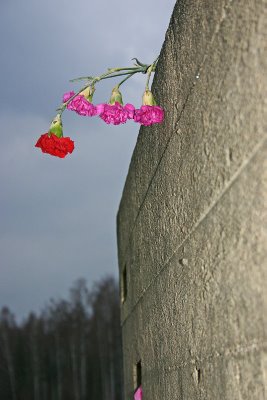
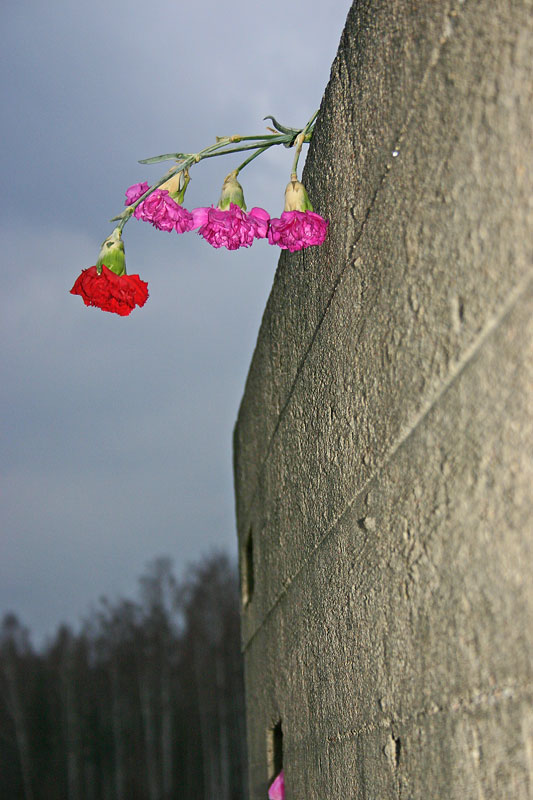
The flowers hang over the edge of a monumental stone which stands to mark the spot where thousands of inmates were hung for misdeeds.


Sachsenhausen, BerlinSalaspils, Latvia